
Dirty Details on NTN Freedom
Return to Page 1
Mode Switching
At first glance you might think you need to bend over to pull up on the pink rubber tab to free the toe for touring, and you can do it that way but then you’d be bending over and didn’t NTN promise to eliminate the need to bend over to get in your bindings? The recommended way is to simply flip up the front lever that unlocks the clamp around your boot’s second heel. When you do this, the mode chingas elbows up, which releases the block that prevents the toe from rotating. With this up, quickly push the forward lever down again, clamping your boot, but leaving the toe unlocked so it can pivot. Purty ingenious actually.
Touring Efficiency
Unfortunately the pivot is not without some resistance. Your feet and legs can hardly notice, at least for a few thousand steps and if the trail is already broken. After more than five thousand steps that little bit of resistance will steadily chew away at your stamina by requiring more energy per step. Where you may notice it immediately is when breaking trail in blower and the tips of your skis stay submarined as you trench your way up through the trees, otherwise it will just insure you get a full workout on a long day.
The other place a few of you may notice is when executing a snap-kick turn. It isn’t that you can’t do it, but you need to have your timing down because as fast as the tip is snapped up it will rebound down just as fast. Furthermore, because of that ever present spring tension you need to have some power behind the snap kick, because the tip will not simply float up with a light tap. By comparison, a Dynafit tip often lifts on its own without even needing to be coaxed. The Freedom needs a healthy slap to get it to cooperate, but not one that can’t be mastered with a bit o’ practice. For those who don’t see the need to know how to do this, I guess ignorance is bliss, eh?
At least the range of motion is a respectable 50°+. You’ll probably get more when you include the flexibility of the boot itself, but the toeplate only goes to 50° before it limits out, and equally important, that mild resistance in the first 40° of rotation is relatively benign. As it approaches 50° it becomes significant enough to drive your ski tips down.
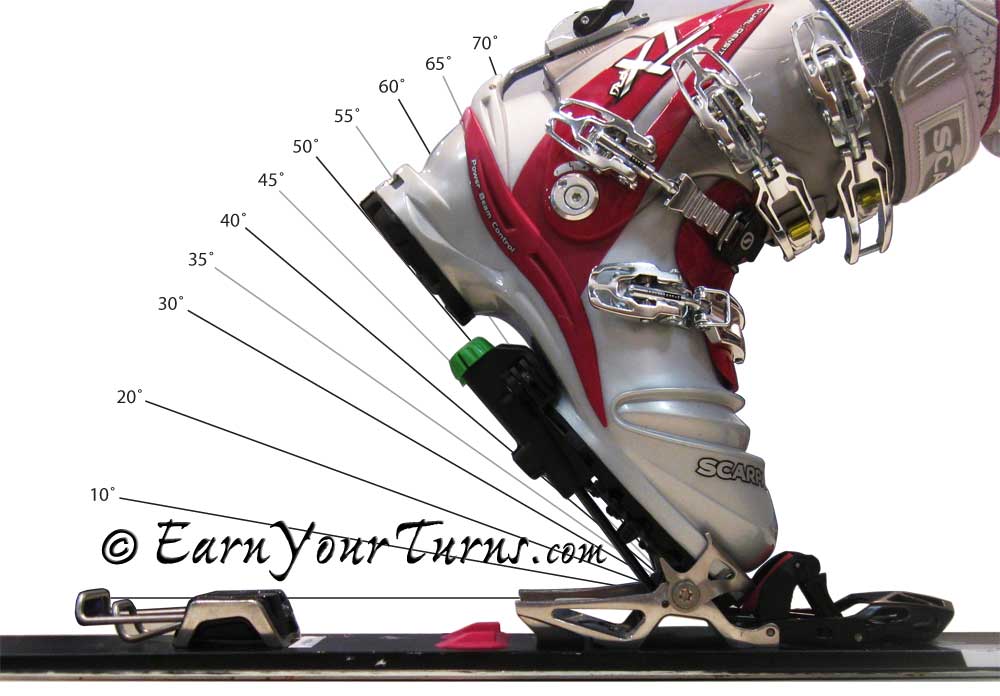
Freedom delivers a healthy 50°-plus ROM with a little bit of resistance, but not much.
This mild resistance is beneficial when sidestepping a traverse, keeping the tails of your skis closer to your heels.
Freedom comes with two climbing pegs that engage easily by simply pulling lightly with the underside of a ski pole grip. At this time, ski crampons are not offered but with a bit of ingenuity B&D will offer something if there is enough demand for them.
Icing on the cake
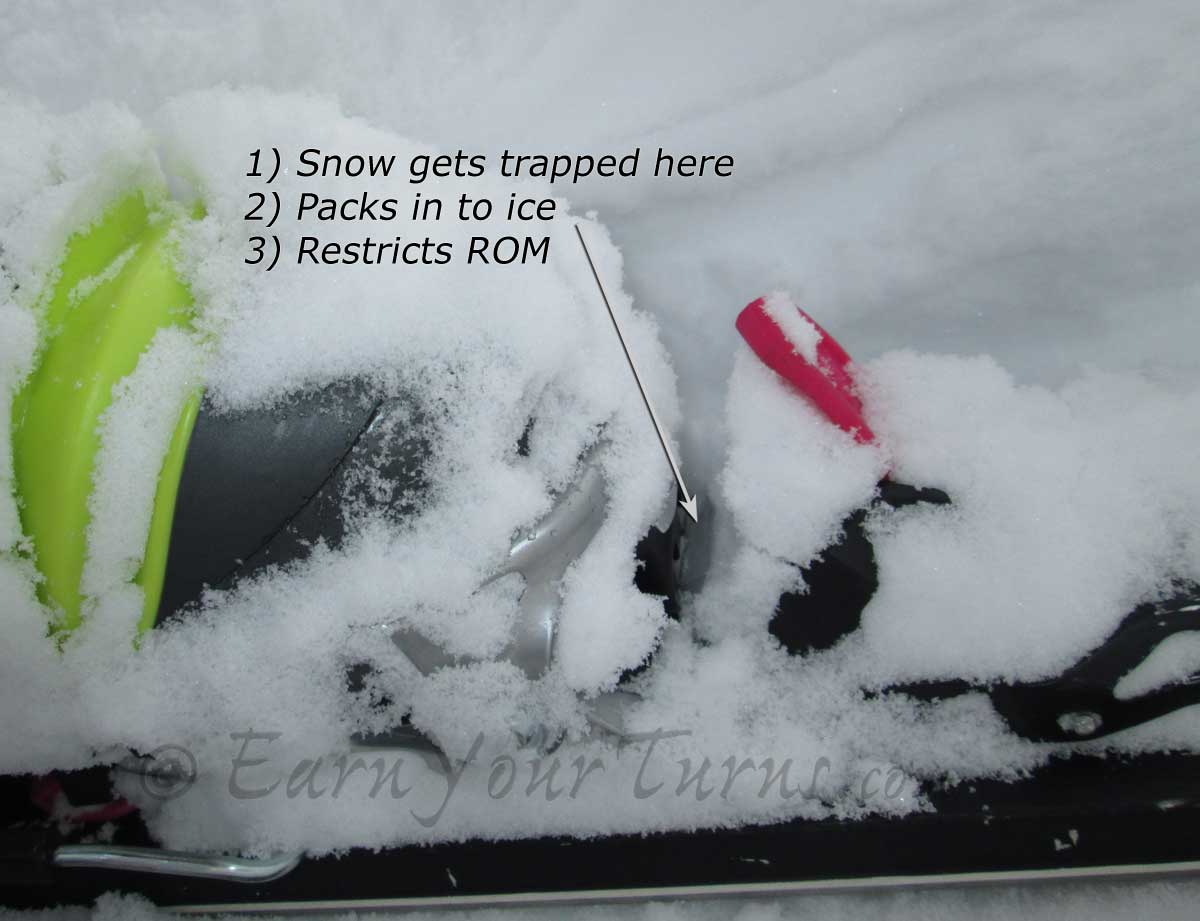
The front of the binding is a multi-port snow trap that enhances ice build up.
No, not the delicious topping to make you desire it more, but the ice that builds up in the nooks and crannies to block the way when you want to change modes. The Freedom has its share of icing problems, two on the uptrack, and one on the down. On three successive tours at Sugar Bowl with cold, fresh snow, the Freedom iced up. There is a trap in front of the boot toe and snow gets sucked in there where the toe packs it down into a nice bumper of ice, limiting the touring range of motion dramatically. That was the first tour in soft, cold, but moist snow. On the next tour, airy light, cold, and drier snow but it still bonded – this time to the underside of the power box providing heel lift when I didn’t want it.
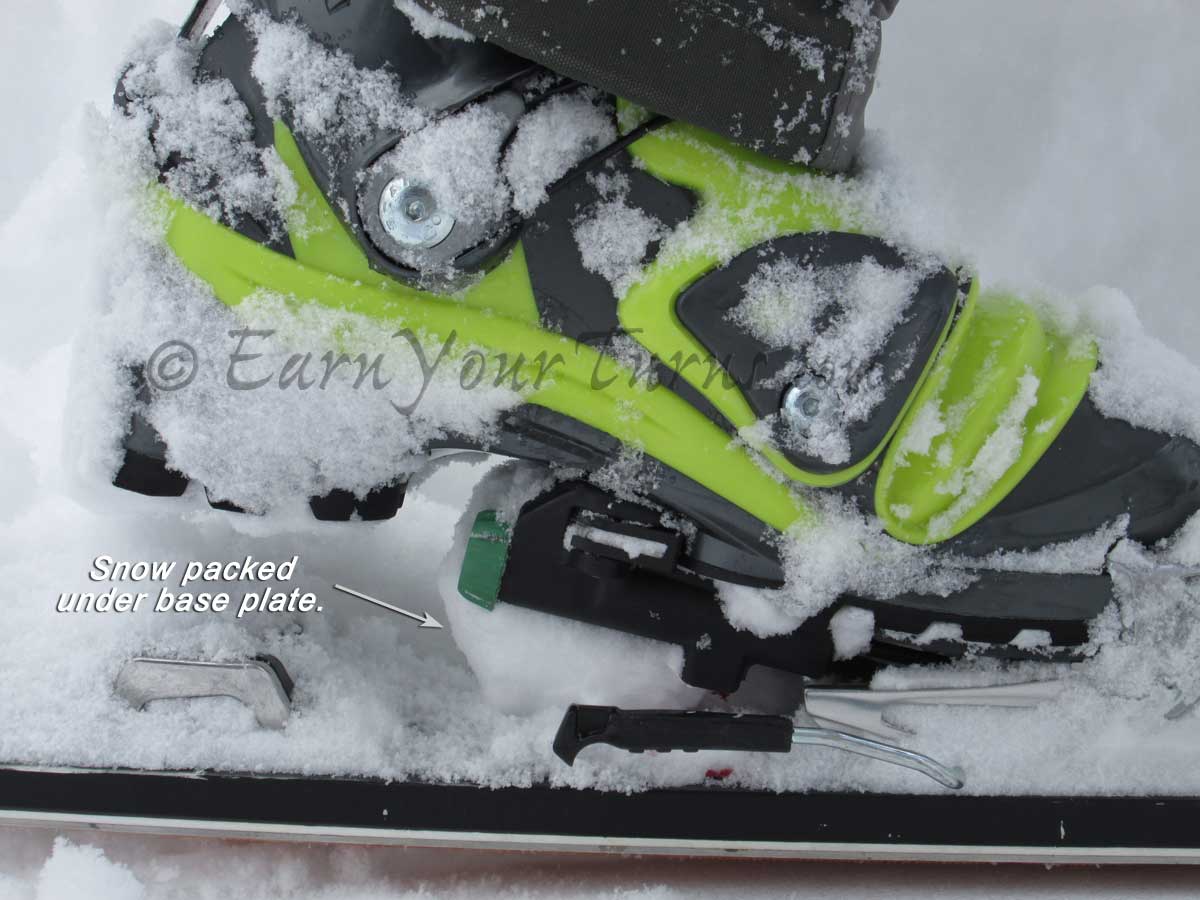
Impromptu climbing post glams on under the power box.
Those are somewhat forgiveable, and every binding has their icing issues. Are they as bad or worse than others? That remains to be seen as reports appear via the wired community. If you’re willing to live with a little resistance in the pivot, an occasional icing problem won’t ruin your day either – depending, of course, on how occasional that occasional is.
The key cause for concern is not these icing issues, but one that affects turning. If you look at the area in front of the boot toe, the touring switch with the pink rubber tab on it creates a lot of cavities that collect snow. If the snow gets packed down it can prevent the touring switch from locking the toe for making turns. When you give the binding a strong forward flexing push it can pop up, putting you in “insta-tele” mode. Yes, I know, you were already tele’ing, but now the resistance is missing. It happened three times on a 1500 foot descent in cold smoke.
Brakes
Gotta love the brakes for keeping your skis from taking off on their own and while kicking in to the binding. In order to get the brakes to retract you need push ’em down with your foot while sliding forward; when done quickly it’s a small kicking motion.
Now I hate to beat a dead horse but another niggling thing came up while going uphill. Everyone once in awhile I’d accidentally hook the brake on the opposite ski because they hang off the side so far on my skis. With slightly wider skis that might be less of an issue, but it sure would be nice if they retracted tighter and with the arms aimed toward the center a bit so they couldn’t hook up on the opposing ski. I’m concerned that someday down the line when I hook that brake I’m going to break it, or at least bend it.
And then while taking my skins off, the skin got snagged by the brake arm. The next time I remembered to make sure it cleared the brake before ripping hard, but not a day later. Harrumph.
Safety Release
Can’t really say yet how the release differs from the Freeride. In theory, not at all, and so far, I haven’t been in a position to test it much. I did take a tumble when I skied over a patch of rocks last week but they didn’t release and they didn’t need to. The only harm was to the base of the skis, not my knees.
One thing that I am truly fond of is the potential for these bindings to release in an avalanche. Of all the bindings out there only NTN offers the possiblity of leaning forward and popping the front lever up, quickly releasing your boot manually from the ski. I don’t know any other binding that could be released that easily. Would you be able to do that in an avalanche? Maybe — which is a whole lot better than your chances with an alpine binding cranked up to 12 or higher, or worse, a SuperLoop.
Turning
Another thing that cannot be denied is the smooth turning sensation of telemarking with Rottefella’s Freedom. It’s as smooth as a Switchback but a bit stronger, like the X2, HH#3, or Enzo #2, but less than Axl#1.
A key part of that is the ramp angle on the toe which works like a surrogate duckbill to get the bellows of the boot to flex sooner in the turn. It helps eliminate the dead spot at the beginning of a turn with the Freeride, where the boot sole could lift and the springs weren’t engaged much yet. The result is a smooth, even sensation when driving the rear ski with your knee cocked — from initiation all the way through the power phase.

A negative ramp angle on the toe helps with faster turn initiation and bellows flex.
On firm snow it is admittedly not as precise as the Freeride. However, it isn’t trying to be either. When you need to dig in your edges to really hold on it just requires more input from the rider.
Installing
A key change with the Freedom is the adoption of a new mounting pattern. This affects the mounting plates of future Freerides too. It is a five hole pattern, although the fifth, forward hole adds little to retention integrity and the remaining four are wider than the 4-hole Targa pattern.
With a jig it’s a pretty straight forward installation, although pressing the heel cover over the climbing bars takes a bit of well focused force to install. I shudder think how to dismantle it without cracking the cap.
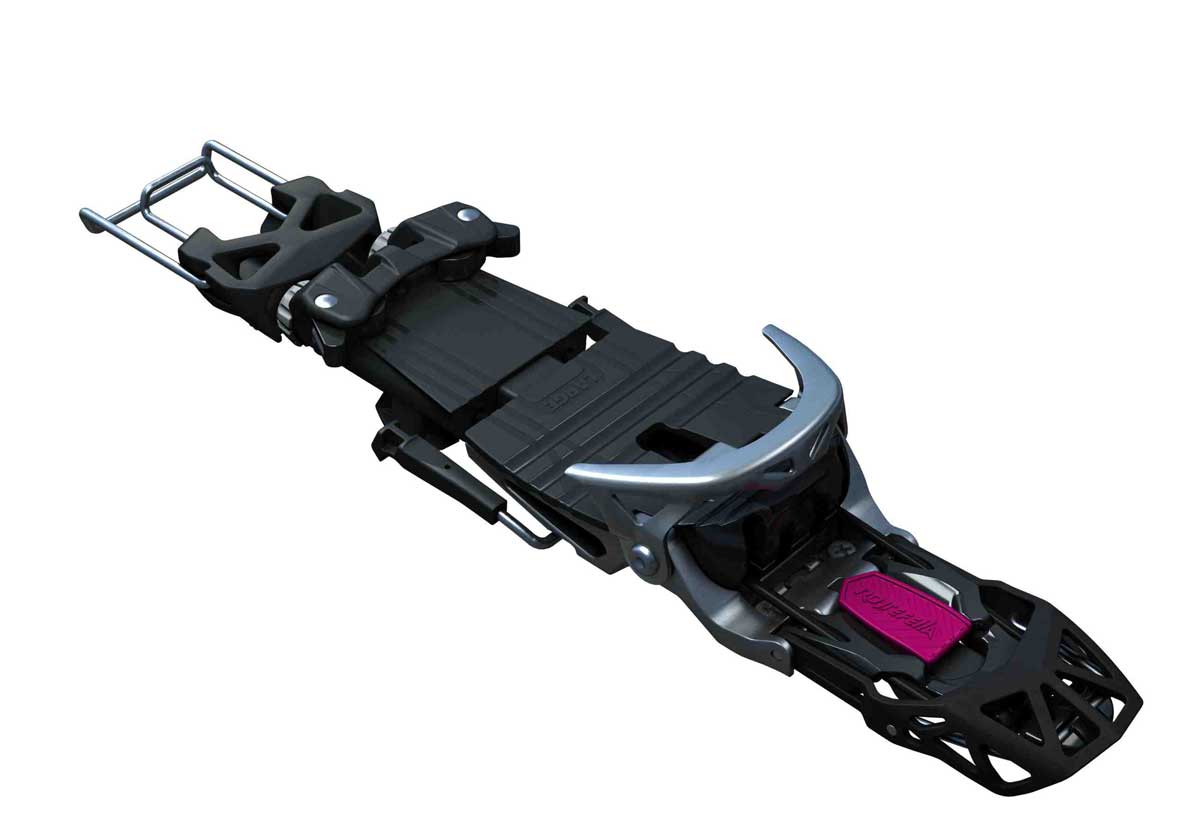
Rottefella’s NTN Freedom. Excellent skiing, acceptable touring.
If you’re been watching and waiting for NTN to grow up, it has. If the reports of NTN being too active kept you away, the Freedom is probably the right level of activity for you, with a significantly improved tour mode. It is lighter, dropping from the fat to the middle weight category, but it won’t qualify for welter weight. It has a safety release, and brakes. Are all those features compelling enough to switch? If safety release is high on your list, this is not a tele binding to be ignored.
Rottefella
NTN Freedom
MSRP: $430
Weight/pr: 3 lbs., 6 oz. (1.53 kg)
Touring ROM: 50°
Sizes avail: Small (≤ mondo 26.0), Large (≥ 26.5)
Related Posts
First Look: NTN Freedom (2012)
Review: NTN Freeride (2011)
Review: NTN Freeride (2007)
On the Fence w/NTN
NTN Revelation
© 2012
Pages:
- 1
- 2

21 pings
Skip to comment form
[…] Posts Review of NTN Freedom Review of NTN […]
[…] and less weight, but for that you’ll have to wait for Rottefella’s touring version (Freedom), available soon, geologically speaking. NTN Freeride 11/12 • $ 395 • 4 lbs. 1 oz. (1.85 kg) […]
[…] that there are four choices, Rottefella’s first NTN binding, the Freeride, now joined by the Freedom which is getting rave reviews for excellent downhill performance and kudos for improved touring […]
[…] pivot is in front of pin line. Not just a little, a full 30mm, no less. It tours better than the NTN Freedom because it has less resistance, but on a long climb it isn’t as efficient as an O1 where the […]
[…] Since penning this article Rottefella has added the Freedom binding to the list of options, so now there are four valid NTN bindings. TTS is maturing. […]
[…] worth noting this flex phenomenon is more problematic with TTS bindings than it is with the NTN Freedom or Freeride […]
[…] using the TTS binding with the cable tension applied at the heel, than it is when using the NTN Freedom with cable tension at the second heel. I think part of that is due to the reverse ramp angle in the […]
[…] Rottefella Freedom […]
[…] allows you a choice of four different bindings to exercise that control – Rottefella’s NTN Freedom, Freeride, or Burnt Mountain Design’s Spike, or the Dynafit inspired Telemark Tech […]
[…] Posts First Look: NTN Freedom (2012) Review: NTN Freedom Review: NTN Freeride (2011) Review: NTN Freeride […]